
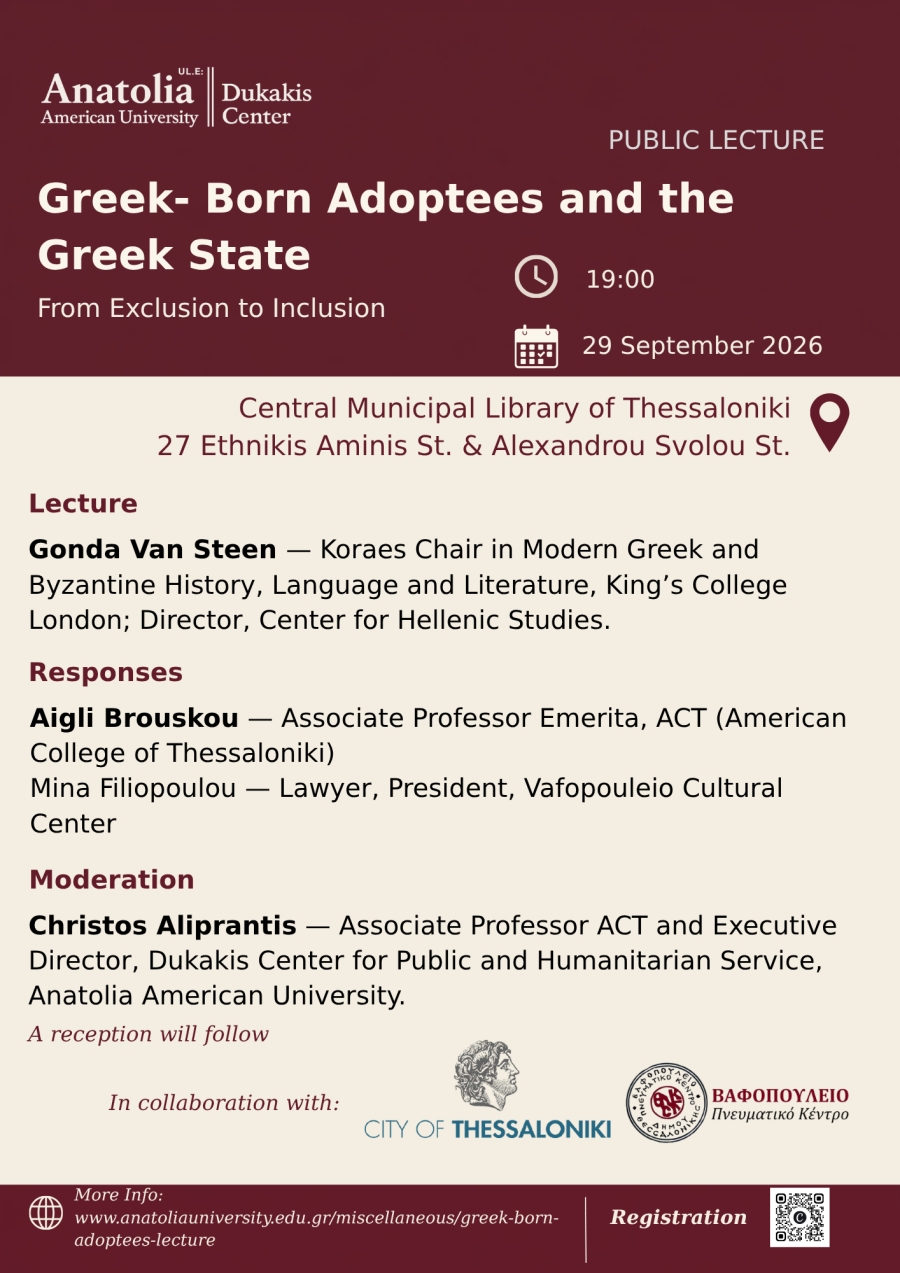
Greek-Born Adoptees and the Greek State: From Exclusion to Inclusion
The Municipality of Thessaloniki, the Vafopouleio Cultural Center and the Michael and Kitty Dukakis Center for Public and Humanitarian Service at Anatolia American University will host a public lecture by Professor Gonda Van Steen, Koraes Chair of Modern Greek and Byzantine History, Language and Literature at King’s College London, on Tuesday, 29 September 2026, at 7:00 p.m. The lecture, entitled “Adoptees of Greek Origin and the Greek State: From Exclusion to Inclusion,” will take place in the “Dinos Christianopoulos” Events Hall of the Central Municipal Library of Thessaloniki, and will be conducted in English with consecutive Greek interpretation.
In the decades following the Second World War and the Greek Civil War, and up to the mid-1970s, some 4,000 Greek-born children were sent abroad for adoption, chiefly to the United States and the Netherlands, and also to Sweden. Poverty, the aftermath of war, and the stigma attached to unmarried motherhood led many families to give up their children, often under pressure or without fully understanding that the children would leave the country for good. For decades, these adoptees faced serious bureaucratic obstacles when they sought their adoption records, their birth families, or recognition by the Greek state.
Professor Van Steen has studied this little-known chapter of postwar Greek history in depth. Her book Adoption, Memory, and Cold War Greece: Kid pro quo? (University of Michigan Press, 2019; Greek edition Ζητούνται παιδιά από την Ελλάδα, Potamos, 2021) drew on extensive archival research and personal testimonies to show how intercountry adoption became entangled with the politics and humanitarianism of the Cold War. In a recent edited volume, she examines the work of the American social worker Charles Schermerhorn in Thessaloniki between 1946 and 1951, shedding light on the history of the very city hosting the lecture.
Beyond her scholarship, Professor Van Steen has been a leading figure, together with Greek-born adoptee Dr. Mary Cardaras, in the Nostos for Greek-Born Adoptees campaign, which gathered more than 75,000 signatures worldwide. The campaign helped bring about the 2025 reform through which the Greek state opened a path for adoptees to restore their Greek citizenship and made it easier for them to access adoption records. In Thessaloniki, she will trace the journey from decades of silence and exclusion toward recognition and inclusion, and discuss the questions that remain open.
Gonda Van Steen will be in conversation with Dr. Aigli Brouskou, Emerita Associate Professor of Social Anthropology at the American College of Thessaloniki (ACT), researcher specializing in the history of child protection institutions, adoption, and social care in modern Greece, and author of the book Due to the Crisis, I Am Giving You My Child (SYMEPE Publications, 2015); and Mina Filiopoulou, Supreme Court attorney specializing in Family Law and President of the Advisory Board of the Vafopouleio Cultural Center.
The event will be moderated by Dr. Christos Aliprantis, Executive Director of the Michael and Kitty Dukakis Center.
Gonda Van Steen has held the Koraes Chair of Modern Greek and Byzantine History, Language and Literature at King’s College London since 2018 — the first woman to hold the post — and directs the Centre for Hellenic Studies. She studied Classics in Ghent and received her PhD from Princeton University. She previously held the Cassas Chair in Greek Studies at the University of Florida and served as President of the Modern Greek Studies Association. Her work spans the modern reception of antiquity in Greece, theater under the military dictatorship, and the history of postwar adoptions.
Event details
Date and time: Tuesday, 29 September 2026, 7:00 p.m.
Venue: “Dinos Christianopoulos” Events Hall, Central Municipal Library of Thessaloniki, 27 Ethnikis Amynis St. & Alexandrou Svolou St., Thessaloniki
Admission: Free entry upon online RSVP
Language: English with consecutive Greek interpretation.
